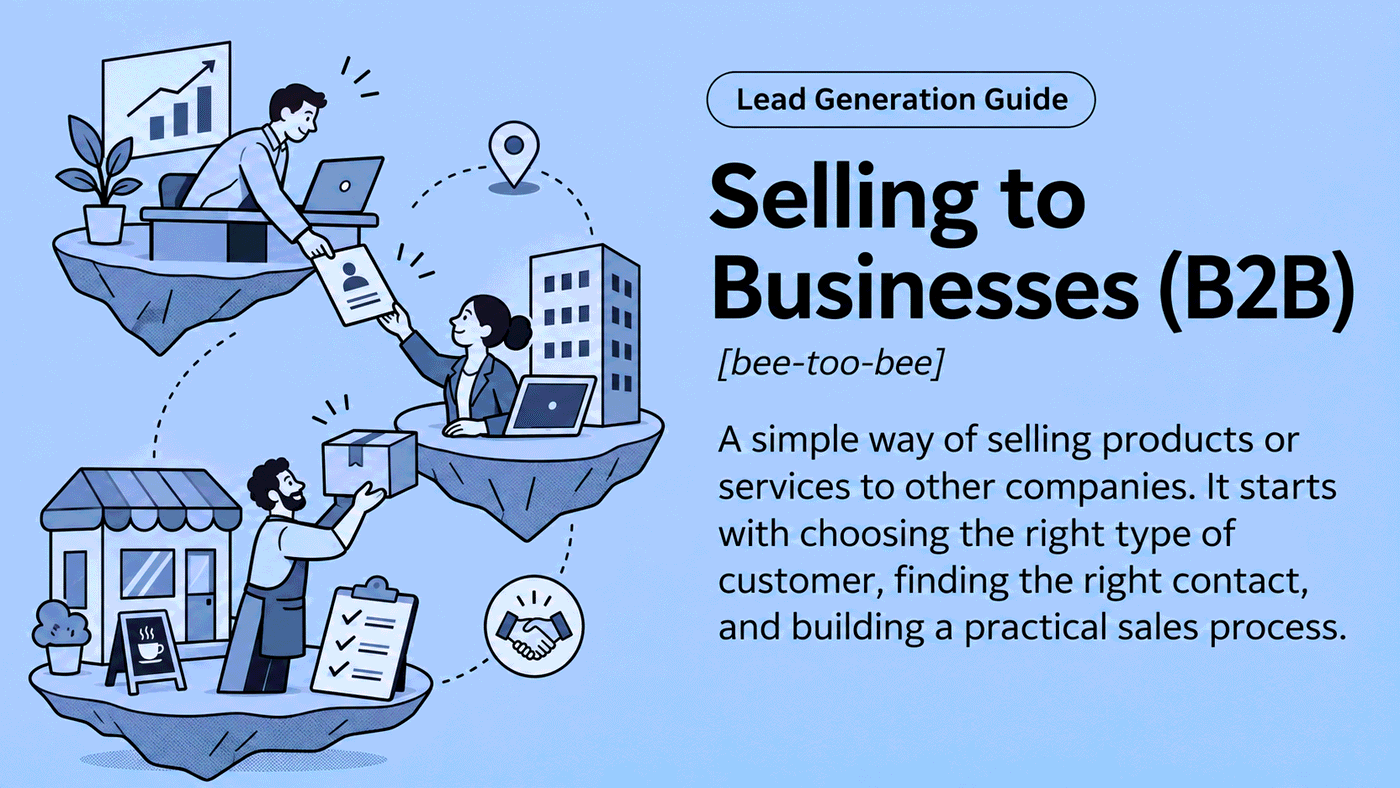
B2B, or business-to-business, means selling products or services to another business rather than to an individual consumer. To make it work, choose a specific type of customer, understand the business problem you solve, and build a sales process that connects the right prospect with a clear, deliverable offer.
What makes a sale B2B?
The buyer’s purpose matters more than the product itself. A cleaning service hired by a homeowner is a consumer sale. The same service hired to maintain a restaurant is a B2B sale. A retailer purchasing stock from a supplier is also participating in B2B commerce, as explained in Investopedia’s overview of business-to-business transactions.
B2B is not limited to manufacturers, wholesalers or large corporations. A freelance designer working for a dental practice, an agency managing a hotel’s marketing, and a maintenance company serving office buildings are all selling to businesses.
For a seller, the practical question is: What business task will the buyer be able to perform better after purchasing? Your answer should describe a useful outcome, not simply name your service.
For example, “website design” describes what you provide. “Make it easier for prospective patients to find your services and request an appointment” describes why a practice might care. The outcome still needs to be realistic; do not promise results you cannot control.
Choose a customer segment before building a list
“Local businesses” is a market description, not a useful prospecting plan. Restaurants, accountants and auto repair shops have different workflows, buying responsibilities and service needs.
Start with a segment that your offer can serve well. Define it using criteria you can actually check:
- Business type: What does the company do?
- Service area: Where can you sell and deliver your work?
- Relevant activity: Does the business offer the service or operate the facility your solution supports?
- Requirements: Can you meet its likely operational needs?
- Exclusions: Which businesses would be a poor fit, even if they wanted to buy?
Suppose you provide commercial kitchen equipment maintenance. Restaurants with commercial kitchens are a more relevant starting point than a general list of food businesses. You would still need to confirm equipment requirements, access arrangements and whether maintenance decisions are handled locally.
Write a simple targeting statement:
We help restaurants in our service area maintain kitchen equipment, provided their equipment and scheduling requirements match what we can support.
This gives you a rule for researching prospects and declining unsuitable work.
Build a prospect list that supports decisions
A useful list is not just a collection of contact details. It should help you decide which businesses deserve further research and what to do next.
Keep basic business information separate from your sales judgments. A company’s address is an observed fact. “Likely needs a new supplier” is a hypothesis until someone confirms it.
Useful fields include:
- Business name, category and location.
- Website and publicly listed contact channels.
- A factual reason the business appears relevant.
- The source of any named contact or role.
- Questions that remain unanswered.
- Current status and the next agreed action.
ScrapePlaces can support the list-building stage: users choose a business type and place, see an estimate, and then collect matching Google Maps records, including name, address, phone, website, rating and category. Optional enrichment adds public website information such as emails and social links; a research feature looks for people handling marketing, partnerships or purchasing and provides a source for each person found. Lists can be filtered, combined and exported. The workflow guide explains the process, while the business data overview explains the fields and their origins. Availability depends on what businesses publish.
Whatever method you use, review records before contacting them. Check for duplicate locations, irrelevant categories and websites that no longer represent the business. Missing information should remain marked as missing rather than filled with assumptions.
Find the right buying role
The person who answers the phone may not choose suppliers. The person who uses your service may not approve the agreement. Treat those as separate possibilities.
B2B purchases can involve multiple stakeholders and formal decision-making, which can make the sales process longer than a consumer purchase. Investopedia’s discussion of B2B buying challenges describes these differences.
Research the role before focusing on a name. Depending on your offer, you may need an owner, practice manager, facilities manager, marketing lead or purchasing contact. A business website can provide clues, but a published title does not automatically establish purchasing authority.
If responsibility is unclear, ask a routing question:
Who handles equipment maintenance suppliers for this location?
That is more useful than delivering a full sales pitch to an unrelated employee. For a business with several locations, also ask whether supplier decisions are made locally or centrally.
Record where the answer came from. A role listed on a website and a responsibility confirmed directly by the business are different kinds of evidence.
Turn research into a relevant first message
Your first message should explain why you are contacting this business, what you offer and what response would be useful. It does not need to contain your entire service catalogue.
Use an observation you can verify. If a restaurant’s website says it provides catering, you can refer to that service. You cannot conclude from that fact that its kitchen is overstretched or that its equipment is unreliable.
Here is an illustrative message for a maintenance provider:
Hello, I saw that your restaurant offers catering alongside regular service. We provide commercial kitchen equipment maintenance in your area. Do you handle maintenance suppliers locally, or should I speak with someone else?
The message establishes relevance without pretending to know the buyer’s problems. If the recipient confirms responsibility, the next conversation can explore requirements.
Before sending outreach, check the rules that apply to your location, the recipient’s location and the channel you intend to use. Do not treat publicly available contact information as blanket permission to send promotional messages. Respect requests not to be contacted.
Qualify the opportunity before proposing work
A business can match your target segment without being ready or suitable to buy. Qualification means checking whether there is a real problem, an appropriate decision process and a service requirement you can meet.
Ask questions that help both sides evaluate fit:
- How is this task handled now?
- What is working, and what would you like to change?
- What would a satisfactory outcome look like?
- Who needs to review a new supplier?
- Are there access, scheduling or documentation requirements?
- Is there an existing agreement that affects when a change is possible?
Listen for specific requirements rather than collecting agreement with your pitch. “We need support outside opening hours” tells you something actionable. “That sounds interesting” does not establish a buying need.
Document the answers in the buyer’s terms. If you cannot meet an essential requirement, say so before preparing a proposal. A poor-fit agreement can create delivery problems that better prospecting would have avoided.
Make the proposal and negotiation concrete
A proposal should connect the buyer’s stated need to the work you will perform. Make responsibilities and boundaries visible rather than leaving them for the delivery team to discover later.
Include the intended outcome, scope, exclusions, customer responsibilities, scheduling arrangements and acceptance criteria. Explain how changes will be approved and who will act as the contact on each side.
Prepare for negotiation by identifying what you can adjust and what you cannot responsibly promise. Investopedia’s guide to negotiation preparation and strategies emphasizes understanding both parties’ objectives, preparing acceptable concessions and knowing when to walk away.
In practice, this might mean discussing a different start date, a narrower scope or a staged rollout. If the buyer asks for faster delivery, explain which conditions would make that feasible. Do not agree to a deadline that depends on resources you do not have.
Confirm agreed terms in writing so that sales promises and delivery expectations stay aligned.
Use a working review checklist
Review your active opportunities regularly. The goal is to find the next useful action, not to keep every prospect marked as interested.
For each business, check:
- Fit: Does it still match your target segment?
- Evidence: Are your notes based on verified information or assumptions?
- Responsibility: Do you know who evaluates and approves the purchase?
- Need: Has the buyer described a problem you can address?
- Action: Is there a clear next step, with someone responsible for it?
- Delivery: Can your team fulfil what has been discussed?
- Contact preferences: Have requests to stop or change communication been recorded?
If an opportunity has stalled, identify what is missing: a relevant contact, a confirmed need, a decision or an agreed next step. Then resolve that gap or remove the business from active follow-up. A manageable pipeline of understood opportunities is more useful than a long list of names with no clear path forward.